ProventusNova vs Elixir Embedded: Which Is Right for Your EdgeAI Hardware Project?
You’ve narrowed your search for embedded software help to a shortlist. Elixir Embedded keeps appearing alongside ProventusNova, and you’re trying to figure out what separates them, and which one actually fits what you’re building.
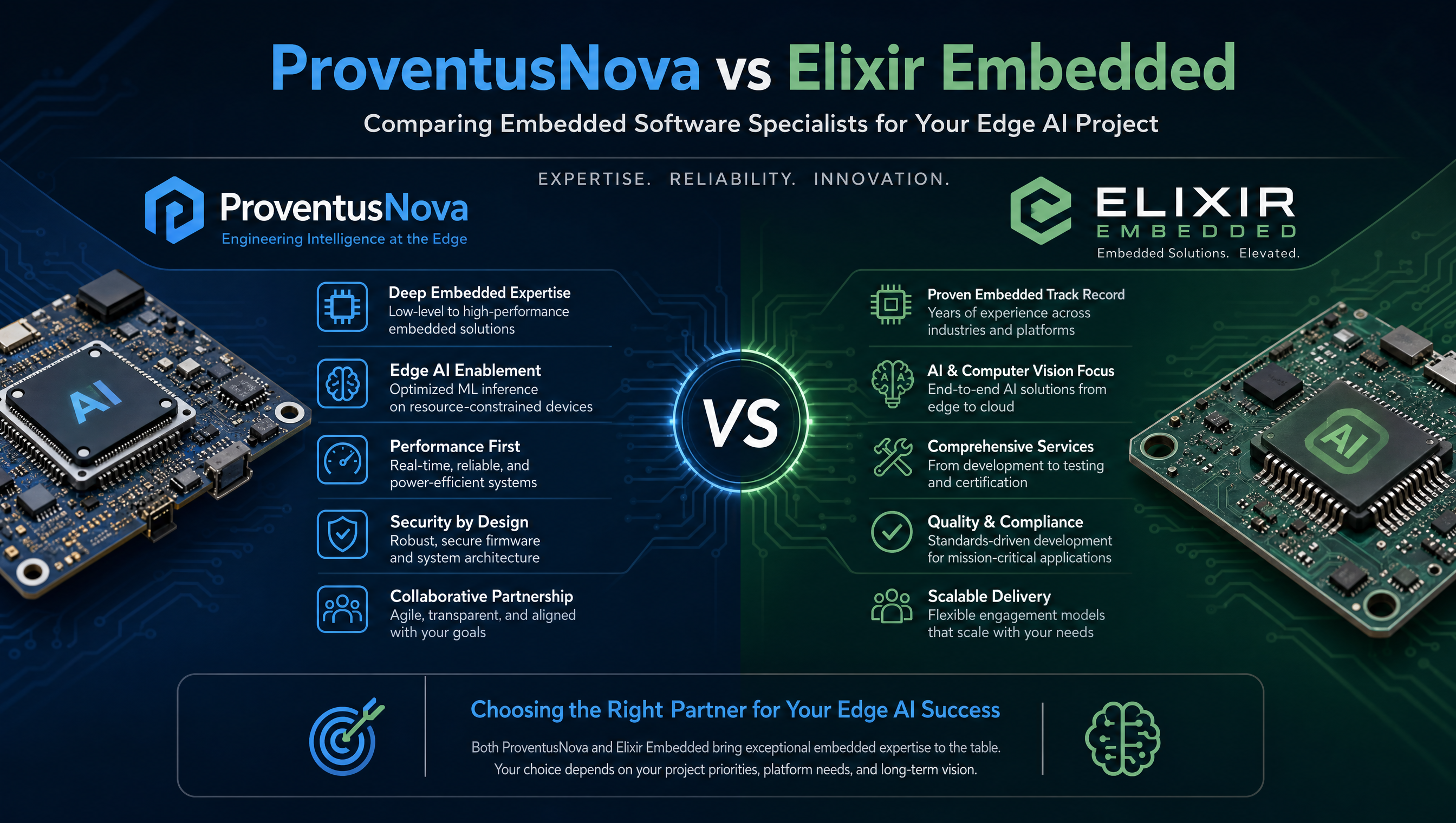
They’re not the same type of company. When founders search for an Elixir Embedded vs contractor comparison, they’re usually asking whether a specialized IoT firmware house is the right fit for their EdgeAI hardware project, or whether they need someone who works at the platform level. Elixir Embedded specializes in Elixir/BEAM firmware at the application and logic layer of IoT-connected devices. ProventusNova specializes in BSP, camera drivers, and AI inference deployment on NVIDIA Jetson and MediaTek Genio, the platform stack that turns a custom carrier board into a working device.
If your project runs on Elixir/Nerves with MQTT connectivity as its technical core, Elixir Embedded is worth a serious evaluation. If you’re building a computer vision or EdgeAI product on NVIDIA Jetson and your blockers are at the board, driver, or inference layer, you’re looking at a different problem entirely.
Key Insights
- Elixir Embedded: Best for IoT firmware on the Elixir/Nerves stack. Application logic, OTA updates, cloud connectivity on BEAM-based targets.
- ProventusNova: Best for EdgeAI hardware startups on NVIDIA Jetson or MediaTek Genio. BSP, camera drivers (CSI, GMSL2), GStreamer pipelines, TensorRT deployment.
- Key difference: Different layers of the stack, not different quality levels. If your blocker is a non-booting carrier board or an unsynced GMSL2 camera, ProventusNova is the relevant choice.
What is Elixir Embedded?
Elixir Embedded is a software consultancy built around the Elixir programming language and the BEAM virtual machine for embedded and IoT applications. Their primary toolchain is Nerves, an open-source framework for building production-grade Elixir firmware on embedded hardware.
The Nerves stack runs on top of a minimal Linux environment and gives teams a structured, fault-tolerant approach to IoT firmware: OTA update pipelines, reliable MQTT/pub-sub connectivity, runtime introspection, and event-driven state management. BEAM’s process isolation and hot-code swapping make it genuinely useful for devices that need high reliability over long field deployments without physical access for restarts.
Elixir Embedded’s work is at the application and firmware logic layer. Their clients have typically already decided to build on Elixir and Nerves and need specialists who know the stack deeply, not contractors who learn it on their time. They’ve contributed to the Nerves ecosystem directly. The frameworks their clients build on have benefited from Elixir Embedded’s own work. You can tell the difference between a team that uses a framework and one that’s fixed bugs in it.
Their expertise doesn’t extend below the application layer. NVIDIA Jetson BSP configuration, JetPack 6 kernel patches, GMSL2 and CSI camera driver development under V4L2, GStreamer pipeline architecture, TensorRT/DLA inference optimization: that’s a different technical domain. Not adjacent. Different.
Elixir Embedded vs contractor: head-to-head comparison
| Elixir Embedded | ProventusNova | |
|---|---|---|
| Core specialty | Elixir/BEAM/Nerves firmware for IoT | BSP, camera drivers, EdgeAI deployment on Jetson/Genio |
| Platforms supported | BEAM VM targets (ARM/x86 via Nerves) | NVIDIA Jetson (Orin, AGX, NX), MediaTek Genio 700/1200 |
| Pricing model | Not publicly specified | Fixed-bid (preferred), hourly, or monthly subscription |
| Delivery guarantee | Not specified | 50% discount if milestone delayed; zero cost if unsatisfied after 2 weeks |
| IP transfer | Not specified | Full IP transfer on completion, no vendor lock-in |
| Risk-free first milestone | Not specified | Proof Sprint™ (7-14 days) |
| Typical turnaround | Not specified | Board BringUp: 7 days; Camera integration: 14-21 days |
| Best suited for | IoT products on Elixir/Nerves stack | EdgeAI hardware startups on Jetson or Genio |
“Not specified” reflects what’s publicly available, a factual gap, not a negative judgment.
Where Elixir Embedded excels
Elixir Embedded knows their domain. A happy customer of theirs would agree with what follows.
BEAM’s process isolation means a crashed subsystem doesn’t take down the device. Hot-code swapping means OTA firmware updates without reboots. For products with MTBF requirements measured in years and no physical access after deployment, these are real engineering properties, not marketing language.
They’ve contributed to the Nerves ecosystem directly. The frameworks their clients build on have benefited from Elixir Embedded’s own work. You can tell the difference between a team that uses a framework and one that’s fixed bugs in it.
If the firmware architecture is Elixir-based and the primary challenges involve connectivity reliability, cloud integration, device state management, or OTA robustness, they’re the right call. A generalist embedded contractor won’t touch this stack for months without expensive ramp time.
One hard constraint: their expertise stops at the application layer. BSP and driver work on Jetson needs a different toolchain entirely. Linux kernel, device tree, V4L2, GStreamer, TensorRT. Different hands to execute it.
Where ProventusNova has the edge for EdgeAI hardware projects
1. Platform specificity from the kernel up
Our work starts at the board. BSPs, U-Boot bootloader config, device trees, PCIe lane assignment, USB enumeration on JetPack 6. This is our primary domain. We’ve diagnosed and fixed these problems on production hardware for hardware startups at every stage from early prototype to field trial.
The most common situation: a founder calls after their team has been blocked for two to four weeks on something they can’t find documented anywhere. That’s Driver Hell™. USB enumeration failure on JetPack 6. The forums don’t have the answer. We do, because we’ve been in that exact kernel configuration before, on a different startup’s board, six months ago.
If your carrier board isn’t booting, or your GMSL2 camera isn’t delivering frames to the V4L2 subsystem, you need someone who has debugged that exact combination of hardware, kernel version, and BSP configuration. That’s not Elixir firmware work.
2. Pricing with a delivery guarantee
We work fixed-bid, hourly, or monthly subscription depending on what fits the scope. For bounded work like board bringup or camera driver integration, fixed-bid is our preference because it aligns incentives: if it takes longer, we bear that cost, not you. For ongoing retainers or exploratory work, hourly or monthly makes more sense.
Either way, the guarantee is the same. Miss a milestone deadline, the remaining work continues at 50% cost until done. Not satisfied after the first two weeks of a Proof Sprint™, keep the code, documentation, and IP. Pay nothing.
That accountability is what makes the model matter less than the commitment behind it.
3. Full-stack depth: stalled board to investor-ready demo
The Dead Silicon to Demo™ methodology covers the complete embedded stack for EdgeAI hardware: board bring-up, camera pipeline integration (CSI, GMSL2, FPD-Link), GStreamer media processing, TensorRT/DLA inference deployment, handoff documentation, full IP transfer.
Elixir Embedded’s expertise covers a different part of the stack, a valuable part for the right product. For an EdgeAI computer vision product on Jetson, the path from stalled board to running demo is BSP, driver, and inference work. That’s what we do.
Who should choose Elixir Embedded
Elixir Embedded is the right call when the product’s technical core is Elixir-based firmware and the primary engineering challenges are application and connectivity layer: OTA reliability, MQTT connectivity, device state management, cloud integration. You’ve made the architectural choice to build on Elixir, you need someone who knows that stack at production depth, and BEAM’s fault tolerance model is a genuine design requirement, not just a nice-to-have.
Their depth in the Nerves ecosystem is a real advantage in that context. A generalist embedded contractor learns the stack on your time. Elixir Embedded already knows it.
They’re not the right choice if your hardware is NVIDIA Jetson or MediaTek Genio and your blockers are BSP, driver, or inference work. The Elixir/Nerves toolchain doesn’t apply there. If Jetson carrier board bring-up is your specific problem, see our Toradex vs ProventusNova comparison for how those paths differ.
Who should choose ProventusNova
ProventusNova fits if you’re building a computer vision or EdgeAI product on NVIDIA Jetson or MediaTek Genio and the current blocker is platform-level: a non-booting carrier board, an unsynced GMSL2 or CSI camera, or a model that needs to run at production latency in a real time inference pipeline.
If your team has been in Driver Hell™ with USB enumeration failures, camera sync errors, or JetPack compatibility issues for more than two weeks, that’s our specialty. We’ve solved those problems on those platforms for startups at exactly your stage.
Entry point is the Proof Sprint™. One bounded milestone, 7-14 days, fixed price. After two weeks, if you’re not satisfied, keep everything we built and pay nothing. Most of our best client relationships started that way.
What a real Jetson engagement looks like: UncommonLab
UncommonLab called us after their team had spent weeks unable to get a working boot and USB enumeration cycle after upgrading to JetPack 6. The new BSP environment had broken USB functionality in a way that wasn’t documented anywhere. Standard debugging approaches hadn’t surfaced the root cause. The team was burning engineering time.
We found the root cause in 4 hours. Full fix delivered in under 20 hours, less than one business day from first call to validated board.
That turnaround came from having diagnosed the same USB enumeration failure on JetPack 6 on other carrier boards, for other founders, before this call. We already knew where to look. UncommonLab got their board working in under a day. Full IP, no ongoing dependency, no retainer.
That’s the Proof Sprint™ in practice.
Frequently asked questions
How does ProventusNova compare to Elixir Embedded on price?
Elixir Embedded doesn’t publish pricing. ProventusNova charges fixed bid: price is defined before the engagement starts. Entry point is the Proof Sprint™, scoped to one milestone. Miss the deadline, work continues at 50% cost. Not satisfied after two weeks, keep everything and pay nothing.
Does Elixir Embedded support NVIDIA Jetson development?
No. Elixir Embedded specializes in the Elixir/Nerves stack at the application and logic layer. They’re not Jetson BSP, camera driver (CSI, GMSL2, V4L2), or TensorRT/DLA specialists. For Jetson-specific work, ProventusNova is the right call.
What’s the fastest way to get a stalled carrier board or camera driver working on Jetson?
The Proof Sprint™ is a fixed-price, 7-14 day sprint scoped to one milestone: Board BringUp, Camera Driver Integration, or EdgeAI Model Deployment. Not satisfied after two weeks, keep everything built and pay nothing.
What is Elixir Embedded best for?
IoT products on the Elixir/Nerves stack where the primary challenges are application-layer: OTA updates, MQTT connectivity, device state management, cloud integration. Good fit when BEAM fault tolerance is a genuine product reliability requirement.
What makes ProventusNova different from other embedded software contractors?
Exclusive focus on NVIDIA Jetson and MediaTek Genio. Fixed-bid, hourly, or monthly subscription, with a delivery guarantee: 50% cost if a milestone is delayed, zero if you’re unsatisfied after two weeks. Foundational Layers™ pre-validated architecture so engagements take days, not months. Full IP transfer, no vendor lock-in.
Relevant Services
NVIDIA Jetson Expert Support
Stuck on a Jetson bring-up?
We've debugged this failure mode before. BSP, device tree, camera pipelines, OTA, most blockers clear in the first session. No long retainers. No guessing.
Frequently Asked Questions
How does ProventusNova compare to Elixir Embedded on price?
Elixir Embedded doesn't publish pricing publicly. ProventusNova offers fixed-bid, hourly, and monthly subscription engagements. Fixed-bid is the preferred model for bounded scopes, price defined upfront, delivery guaranteed. Entry point is the Proof Sprint™. Miss the deadline, work continues at 50% cost. Not satisfied after two weeks, keep everything and pay nothing.
Does Elixir Embedded support NVIDIA Jetson development?
Elixir Embedded specializes in the Elixir/Nerves stack for IoT firmware at the application and logic layer. They are not Jetson BSP, camera driver (CSI, GMSL2, V4L2), or TensorRT/DLA specialists. For Jetson-specific work, ProventusNova is the relevant choice.
What's the fastest way to get a stalled carrier board or camera driver working on Jetson?
The Proof Sprint™ is a fixed-price, 7-14 day sprint scoped to one milestone: Board BringUp, Camera Driver Integration, or EdgeAI Model Deployment. Not satisfied after two weeks, keep everything built and pay nothing.
What is Elixir Embedded best for?
IoT products on the Elixir/Nerves stack where the primary challenges are application-layer: OTA updates, MQTT connectivity, device state management, cloud integration. A strong choice when BEAM fault tolerance is a genuine product reliability requirement.
What makes ProventusNova different from other embedded software contractors?
Exclusive focus on NVIDIA Jetson and MediaTek Genio. Fixed-bid, hourly, or monthly subscription, with a delivery guarantee: 50% cost if a milestone is delayed, zero if you're unsatisfied after two weeks. Foundational Layers™ pre-validated architecture so engagements take days, not months. Full IP transfer on completion, no vendor lock-in.

Written by
Aarón AnguloCo-Founder & CEO · ProventusNova
Obsessed with client outcomes. Aarón ensures every engagement delivers real results, on time, on scope, no exceptions.
Connect on LinkedInRelated Articles
Top 5 Embedded Software Companies for Jetson EdgeAI
The 5 best embedded software companies for NVIDIA Jetson EdgeAI projects. Platforms, pricing, delivery guarantees, and honest trade-offs compared.
GStreamer alternatives for Jetson: ProventusNova vs RidgeRun compared
Looking for GStreamer alternatives on NVIDIA Jetson? The real technical options (FFmpeg, DeepStream, Multimedia API) plus ProventusNova vs RidgeRun compared.
The 30% Tax™ Is Not an Upwork Problem. It's a Jetson Expertise Problem.
20-30% of every engineering hour on Jetson BSP work is platform ramp. It hits internal teams the same as contractors. Here's what it costs and why.
Custom Carrier Board Not Booting on Jetson Orin: Fixed in One Session
Custom carrier board not booting on Jetson Orin? Farmhand AI's board booted in one session. Three BSP parameters cause most Jetson bring-up failures.