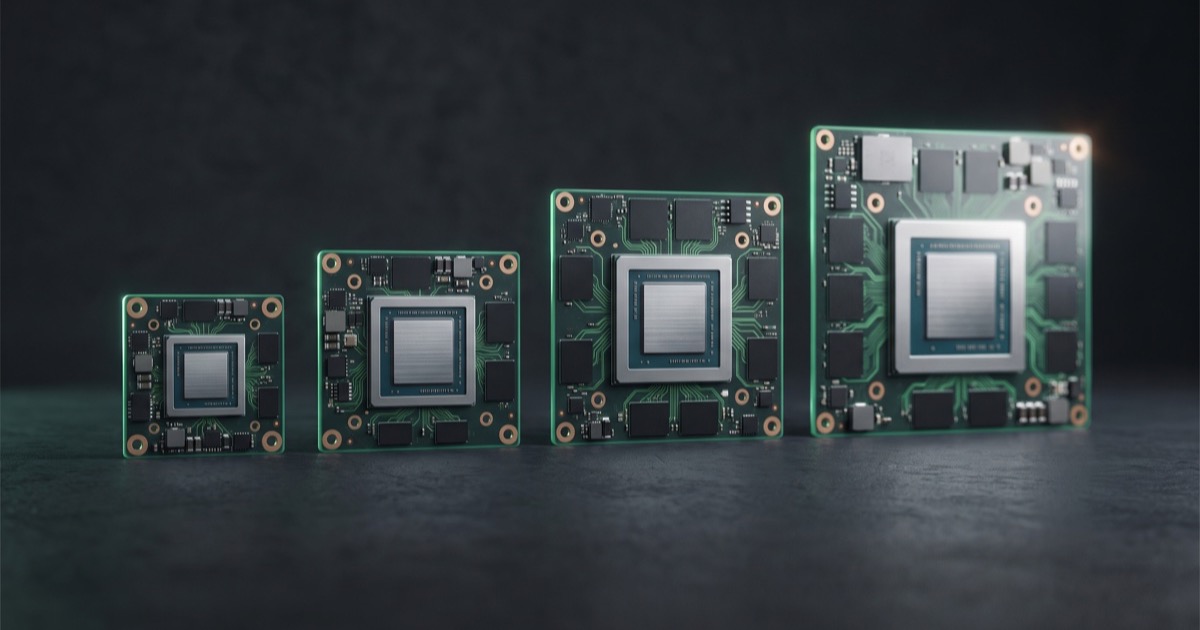
Jetson Thor T3000 and T2000 vs T5000: which module to pick
NVIDIA has filled out the Jetson Thor lineup downward: the T3000 (865 FP4 TFLOPS, 32GB) and T2000 (400 FP4 TFLOPS, 16GB) bring the Blackwell-based Thor architecture into mainstream robotics and edge-AI price and power territory, joining the existing T5000 flagship and T4000. Hardware ships Q1 2027, with T3000 emulation available in JetPack 7.2.1 from late July 2026. The headline engineering fact: the T3000 keeps the T5000’s full 273GB/s memory bandwidth, which is why NVIDIA can claim similar multimodal inference performance at roughly half the size and power.
Key Insights
- T3000 = the LLM value pick on paper: 865 FP4 TFLOPS but the same 273GB/s bandwidth as the T5000, and token generation is bandwidth-bound, not TFLOPS-bound
- T2000 is the volume play: 400 FP4 TFLOPS / 16GB for visual AI agents, AMRs, and industrial manipulators, but its full datasheet is not published yet
- Nothing ships until Q1 2027: plan current designs on Orin or T5000/T4000; start Thor software work in emulation on JetPack 7.2.1
- Jetson Agent Skills are real repos, not marketing:
jetson-device-skillsandjetson-bsp-skillson GitHub, executable by coding agents for Linux customization, memory optimization, and benchmarking - The memory-optimization story is an Orin story today: published results reclaim 4–15GB on Orin-class devices, letting designs drop one memory SKU
What did NVIDIA announce?
Two new modules on the Thor (Blackwell GPU + Arm Neoverse) architecture, positioned below the T5000 and T4000:
- Jetson T3000: 865 FP4 teraflops, 32GB LPDDR5X at 273GB/s, eight-core Arm Neoverse CPU, 25GbE, at “roughly half the size and power of the T5000.” NVIDIA states it achieves similar inference performance to the T5000 for multimodal workloads: LLMs, VLMs, vision-language-action models, and world foundation models.
- Jetson T2000: 400 FP4 teraflops and 16GB of memory, the entry point for visual AI agents, autonomous mobile robots, and industrial manipulators. Detailed specifications (CPU configuration, bandwidth, power range) have not been published; NVIDIA says the datasheet and design guide come closer to release.
With these, the Jetson platform now spans “70 TOPS to 2,000 teraflops”, from Orin Nano to T5000, on one software stack.
Jetson Thor lineup: full spec comparison
| T2000 | T3000 | T4000 | T5000 | |
|---|---|---|---|---|
| AI compute (FP4) | 400 TFLOPS | 865 TFLOPS | 1,200 TFLOPS (sparse) | 2,070 TFLOPS (sparse) |
| GPU | Blackwell | Blackwell | 1,536-core Blackwell, 5th-gen Tensor Cores | 2,560-core Blackwell, 5th-gen Tensor Cores |
| CPU | not yet published | 8-core Arm Neoverse | 12-core Neoverse-V3AE | 14-core Neoverse-V3AE |
| Memory | 16GB | 32GB LPDDR5X | 64GB 256-bit LPDDR5X | 128GB 256-bit LPDDR5X |
| Memory bandwidth | not yet published | 273GB/s | 273GB/s | 273GB/s |
| Power | not yet published | ~half of T5000 | 40–70W | 40–130W |
| Networking | not yet published | 25GbE | 3x 25GbE | 4x 25GbE |
| Availability | Q1 2027 | Q1 2027 | shipping | shipping |
Specs as published by NVIDIA at announcement; T2000 rows marked “not yet published” are exactly that: treat any number you see elsewhere for them as speculation.
Why can the T3000 match the T5000 on LLM inference?
This is the part of the announcement worth an engineer’s attention. The T3000 has well under half the T5000’s FP4 compute, yet NVIDIA claims similar inference performance on multimodal workloads. That claim is credible for a specific reason: LLM token generation is memory-bandwidth-bound. Every generated token walks the full weight set, so decode throughput scales with GB/s, not TFLOPS, and NVIDIA lists both modules at the same 273GB/s.
We see the same physics constantly in LLM work on Jetson Orin: quantization tiers and memory bandwidth dominate tokens-per-second; raw compute sits idle during decode. What the T5000’s extra compute (and 128GB) buys you instead:
- Prefill speed: long-context ingestion is compute-heavy
- Vision encoders and CNN pipelines: genuinely TFLOPS-bound
- Bigger models: 128GB holds weight sets the T3000’s 32GB simply cannot
- Concurrency: batching multiple streams shifts the bottleneck back toward compute
If your workload is “run a quantized multimodal model and stream tokens,” the T3000 is the rational pick. If it’s “many camera streams through heavy vision models plus an LLM,” the T4000/T5000 tiers still earn their price.
What are Jetson Agent Skills?
This is the software half of the announcement, and it’s more concrete than the name suggests. NVIDIA published agent-executable skill repositories on GitHub: jetson-device-skills and jetson-bsp-skills. Each skill is a repeatable recipe (which tools to call, what outputs to produce, how to validate) that a coding agent executes against your Jetson. Three categories shipped:
- Linux customization for custom carrier boards
- Memory optimization across the stack: bootloader memory carveouts, kernel memory reservation, redundant userspace process cleanup
- Model benchmarking and inference optimization
The published results are specific: up to 15GB reclaimed (moving a UBTech/Agile Robots/Connect Tech design from Orin 64GB to Orin 32GB), 4GB reclaimed (SandStar, Orin NX 16GB → 8GB), and a 30% reduction on Jetson TX2 NX (NoTraffic). The pattern NVIDIA is selling: reclaim memory in software, drop one memory SKU in hardware, keep the performance tier. Skills-driven agent automation is the same pattern we run internally for BSP work. It’s a genuine productivity shift when the skills encode real platform knowledge, and NVIDIA encoding its own platform knowledge this way is the strongest endorsement of the approach yet.
Worth noting: these support the entire Jetson portfolio, Orin included: you don’t need Thor hardware to benefit. On JetPack 7.2, Orin and Thor also converge on one stack: Ubuntu 24.04, kernel 6.8, CUDA 13.0.
Which module should you pick?
- Shipping a product in the next 12 months → this announcement changes nothing for you: Orin (Nano/NX/AGX) and the shipping T5000/T4000 are the options. See our Orin module comparison for that decision.
- Designing for 2027 with multimodal/LLM workloads → T3000 is the default candidate: T5000-class decode throughput, half the power and size, 32GB. Start software now in T3000 emulation on JetPack 7.2.1.
- Cost-sensitive volume robotics for 2027 → T2000 on paper, but hold hardware decisions until the datasheet lands. 400 FP4 TFLOPS and 16GB is a real tier jump over Orin NX, but power, bandwidth, and I/O are still unpublished.
- Maximum models, maximum streams → T5000 remains the flagship: 128GB and 2,070 TFLOPS have no substitute in the lineup.
- Existing Orin fleet → the immediately actionable part is Agent Skills: if a memory-optimization pass reclaims even 4GB, moving down one memory SKU at fleet scale is real money, available today, no Thor required.
One BSP-side note for Yocto users: Thor support lives in the master-l4t-r38.x line of meta-tegra (JetPack 7.x), separate from the scarthgap (JetPack 6 / Orin) branch most production builds use today. Budget for that branch split when planning a mixed Orin + Thor fleet.
What should you do before Q1 2027?
- Prototype in emulation: T3000 emulation on JetPack 7.2.1 means the software stack, memory budget, and model selection can be validated months before silicon.
- Run the memory-optimization skills on your current Orin design: the savings are useful regardless of whether you ever move to Thor.
- Re-run your model-selection math against 273GB/s: if you sized your module tier by TFLOPS, the bandwidth-bound reality of LLM decode may move you a tier down.
If you’re planning a Jetson platform decision (Orin now, Thor later, or a migration between them), our Jetson engineering team does this for a living: BSP bring-up, camera pipelines, and model deployment under real memory budgets, on a fixed bid.
Sources: NVIDIA’s announcement, the Jetson Thor product page, and the JetPack 7.2 memory-efficiency deep dive.
Relevant Services
NVIDIA Jetson Expert Support
Stuck on a Jetson bring-up?
We've debugged this failure mode before. BSP, device tree, camera pipelines, OTA, most blockers clear in the first session. No long retainers. No guessing.
Frequently Asked Questions
What are the Jetson Thor T3000 specs?
865 FP4 teraflops of AI compute from a Blackwell GPU, 32GB LPDDR5X at 273GB/s, an eight-core Arm Neoverse CPU, and 25GbE networking, at roughly half the size and power of the T5000. NVIDIA states it achieves similar inference performance to the T5000 for multimodal workloads (LLMs, VLMs, VLAs, world foundation models).
When will the Jetson T3000 and T2000 be available?
Hardware modules are scheduled for Q1 2027. Before that, T3000 emulation mode arrives with JetPack 7.2.1 in late July 2026 so software teams can start now; T2000 emulation follows in a later release. The T2000 datasheet and design guide have not been published yet.
How can the T3000 match the T5000 on LLM inference with less than half the TFLOPS?
Because LLM token generation is memory-bandwidth-bound, not compute-bound. NVIDIA lists both modules at 273GB/s of memory bandwidth, so decode throughput lands in the same range. The T5000's extra compute shows up in prefill speed, vision encoders, and heavy CNN pipelines, not in tokens per second on a chat-style workload.
What are Jetson Agent Skills?
Repeatable, agent-executable task recipes that NVIDIA publishes on GitHub (NVIDIA-AI-IOT/jetson-device-skills and jetson-bsp-skills). You point a coding agent at them and it performs Linux customization, memory optimization, or model benchmarking on your Jetson automatically. They support the whole Jetson portfolio, Thor and Orin, not just the new modules.
Do the JetPack 7.2 memory optimizations work on Jetson Orin?
Yes. The agent skills and memory optimizations target the entire portfolio. NVIDIA's published customer results are mostly Orin: up to 15GB reclaimed letting a design move from Orin 64GB to 32GB, 4GB reclaimed moving Orin NX 16GB to 8GB, and a 30% reduction on TX2 NX. The practical outcome is dropping one memory SKU in the same product tier.
Written by
Andrés CamposCo-Founder & CTO · ProventusNova
8 years deep in embedded systems, from underwater ROVs to edge AI. Andrés leads every technical delivery personally.
Connect on LinkedInRelated Articles
Third-party NVIDIA Jetson carrier board manufacturers compared for edge AI
Third-party Jetson carrier board manufacturers compared: Connect Tech, Leopard Imaging, FRAMOS, Auvidea, Tier IV, Seeed Studio. BSP quality and GMSL2 support.
MediaTek Genio for robotics edge AI: inference, camera, BSP reality
Is MediaTek Genio viable for robotics edge AI? Honest assessment of inference latency, camera pipeline, ROS 2 support, and BSP limitations for robotics builds.
Real-Time Perception on the Edge: Detection, Segmentation, and Depth
A modular edge perception pipeline: open-vocabulary detection, instance segmentation, and depth estimation running locally with live metrics. No cloud.
The 30% Tax™ Is Not an Upwork Problem. It's a Jetson Expertise Problem.
20-30% of every engineering hour on Jetson BSP work is platform ramp. It hits internal teams the same as contractors. Here's what it costs and why.